

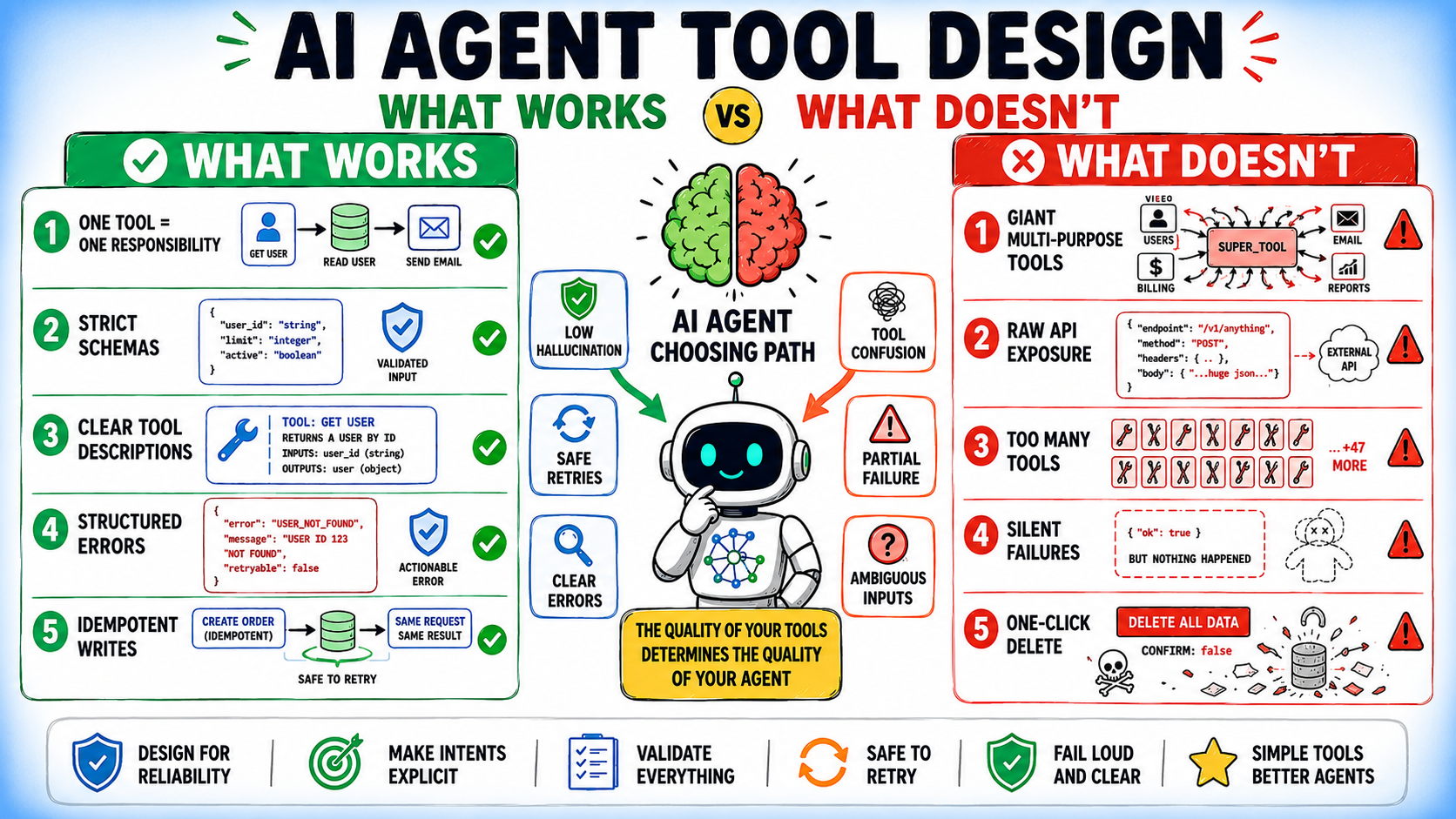
Most AI agent failures look like model mistakes: choosing the wrong tool, passing bad arguments, or mishandling errors. But in practice, the model usually works with the interface it was given. The underlying issue is often the tool design itself.
A model can only reason from the information exposed through the tool interface: the tool name, its description, the parameter schema, and the parameter descriptions. Those details shape how the model interprets intent, plans actions, and executes tasks. When the tool design is unclear, incomplete, or loosely structured, failures become predictable rather than accidental.
Problems such as vague naming, ambiguous instructions, inconsistent schemas, weak parameter definitions, and poor error handling increase the likelihood of failures. Stronger models can reduce some mistakes, but they cannot reliably compensate for a flawed interface. This article covers:
- Tool design practices that improve reliability
- Failure modes that look fine in demos but break under real workloads
- A schema and error design that reduces hallucination at the tool boundarys
What Works in AI Agent Tool Design
1. One Tool, One Responsibility
In most agent systems, a tool should represent a single, clear operation. When one tool handles multiple behaviors through an action parameter, the model must first figure out which mode to invoke before it can solve the actual task.
Single-responsibility tools give the model an unambiguous function and give you cleaner error handling and easier observability.
2. Schemas That Make Invalid States Impossible
In tool-calling agents, the model constructs tool call arguments by reasoning from your schema.
- A loose schema means the model guesses at constraints.
- A tight schema encodes those constraints so no guessing is needed
Enums are particularly useful for fields with a small set of valid values because they eliminate a class of plausible-but-invalid outputs. Validation failures surface at the tool boundary rather than as cryptic downstream errors.
3. Descriptions That Define Scope, Not Just Purpose
Tool descriptions are model-facing documentation. They need to do two things: explain when to use the tool, and explain when not to. Most descriptions only do the first.
Without the disambiguation, the model infers scope from the tool name alone, which is often a reliable source of selection errors at scale. A good tool definition includes clear boundaries from other tools, not just usage instructions.
4. Structured, Actionable Error Returns
When a tool fails, the model reads the error and decides what to do next. An unhandled exception or stack trace produces noise-driven follow-up behavior. A structured error gives the model something to branch on.
5. Idempotent State-Changing Operations
Every tool that mutates state — creates a record, sends a message, transfers funds — must be safe to call twice. In practice, agents retry, networks fail, and the LLM loop may issue a second call because confirmation of the first never arrived.