

What is Artificial Intelligence?
Artificial Intelligence (AI) is when computers are designed to do things that normally require human intelligence. It’s like giving a machine a brain so it can learn and think like a person. One example of AI is a chatbot that can talk to you like a human. You might have used a chatbot when you’ve had a question about customer service on a website or app. The chatbot can understand what you’re asking and respond with an answer just like a real person.
Self-driving cars are another example of AI. These cars use sensors and software to analyze their surroundings and make decisions about how to drive. They see and understand the world around them, much like a human driver. AI has many exciting possibilities, but it also raises important questions about how we use this technology and its impact on our lives.
How Artificial Intelligence Works? (With Example)

To understand how Artificial Intelligence (AI) works, let’s take the example of a face recognition AI system called “Find a Face”.
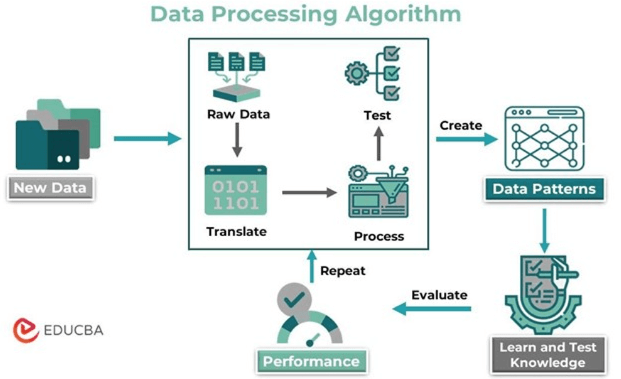
Step #1: The AI system learns to recognize human faces by analyzing a vast dataset of images.
The “Find a Face” system studies numerous images of human faces to train itself to recognize different facial features. The system studies feature such as the position of the eyes and the shape of the nose, which helps it recognize and differentiate human faces from one another.
Step #2: The system uses advanced algorithms to identify distinct patterns in the data.
The “Find a Face” system uses sophisticated machine learning algorithms to identify unique patterns in the data. For instance, it may recognize that certain groupings of pixels in an image often indicate the presence of an eye or other facial feature. By detecting these patterns, the system gets better at identifying faces accurately.
Step #3: The system tests its facial recognition capabilities by analyzing unfamiliar images.
After completing the training phase, the “Find a Face” system analyzes new images that it hasn’t seen before to test its ability to recognize faces. The system attempts to detect the position of facial features in each image and match them to the corresponding landmarks.
Step #4: The system refines its algorithms to improve its facial recognition accuracy.
By analyzing the results of its testing, the “Find a Face” system fine-tunes its algorithms to enhance its facial recognition accuracy. For example, if the system struggles to detect a particular facial feature, it may modify its algorithms to look for other related data patterns. This iterative process of refining algorithms continues until the system can accurately recognize human faces across a broad range of images.
Scope of Artificial Intelligence
|
Areas |
Scope |
|
Natural Language Processing |
Enabling machines to understand and respond to human language in areas such as chatbots, virtual assistants, and sentiment analysis. |
|
Robotics |
Enabling machines to act in the physical world in areas such as autonomous vehicles, drones, and manufacturing automation. |
|
Image and Video Analysis |
Enabling machines to recognize objects, faces, emotions, and more in areas such as facial recognition, object detection, and video surveillance. |
|
Recommendation Systems |
Providing personalized recommendations for products, services, and content in areas such as e-commerce, entertainment, and social media. |
Artificial Intelligence Jobs & Salary
|
Role |
Responsibility |
Salary |
|
Software Developer |
Develop automated software to simplify accomplishing tasks. · SQL · Javascript · C# |
$53,000 – $120,000 |
|
Software Engineer |
Structure separate software functions into one developed program. · Javascript & Java · SQL · Python |
$66,000 – $133,000 |
|
Artificial Intelligence (AI) Researcher |
Create and execute AI tools and evaluate the system’s results. · Machine learning · Deep learning · Python |
$68,000 – $179,000 |
|
Machine Learning Engineer |
Build, test, and implement AI machine learning algorithms. · Machine Learning · Python · Deep learning |
$79,000 – $156,000 |
|
Solutions Architect |
Identify current business issues and create solutions to achieve future goals. · Enterprise solutions · Software architecture · Cloud computing |
$90,000 – $144,000 |
|
Product Manager, Software |
Mediate between clients and internal teams and manage software development. · Product management · Agile software development · Business strategy |
$93,000 – $162,000 |
|
Chief Technology Officer (CTO) |
Lead a team of technical professionals and make crucial business decisions. · Leadership · Software architecture · IT Management |
$81,000 – $395,000 |
|
Vice President (VP), Engineering |
Manage a team of researchers, developers or engineers to attain assigned goals. · Project management · Engineering design · Leadership |
$188,000 – $259,00 |